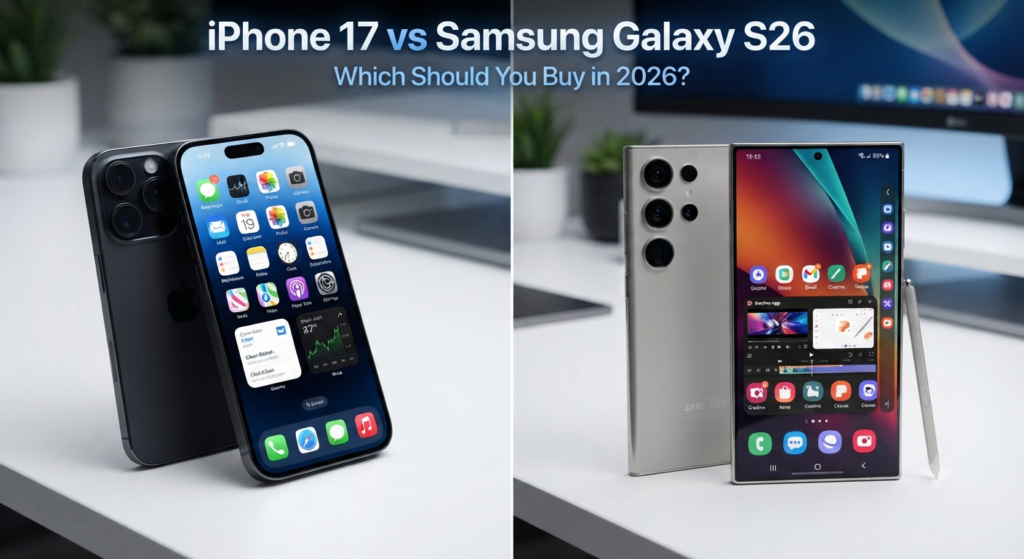
Apple and Samsung continue to dominate the premium smartphone market. The iPhone 17 and Samsung Galaxy S26 represent the absolute best flagship technology available today. Both deliver cutting-edge hardware, advanced AI capabilities, premium cameras, and years of software support.
But which one offers the better overall value for your money?
In this detailed comparison, we evaluate both phones across design, performance, cameras, battery life, and ecosystem advantages to help you decide
Quick Verdict
Buy the iPhone 17 if you:
- Own Apple Gear: You already use a MacBook, iPad, or AirPods.
- Value Simplicity: You prefer a polished, consistent user experience.
- Shoot Mobile Video: You record a lot of video and need industry-leading stabilization.
- Think Long-Term: You want the highest possible resale value down the road.
Buy the Galaxy S26 if you:
- Love Android: You prefer open-source software and deep UI customization.
- Multitask Heavily: You frequently use split-screen apps and Dex features.
- Want Speed: You want faster wired charging speeds.
- Need Zoom Flexibility: You want a dedicated optical zoom lens.
Table of Contents
Head-to-Head Specification Breakdown
Apple iPhone 17
₹82,900.00
|
Samsung Galaxy S26
₹87,999.00
|
|
|---|---|---|
| Display | 120Hz ProMotion OLED | 120Hz Dynamic AMOLED 2X |
| Processor | Apple A19 Bionic | Snapdragon 8 Gen 5 / Exynos |
| Base RAM Memory | 8GB RAM | 12GB RAM standard |
| Hardware Controls | Action Button + Tactile Camera Control Trackpad | Standard Power + Volume Rockers |
| Main Camera | Dual: 48MP Main + 48MP Ultra-Wide | Triple: 50MP Main + 12MP Ultra-Wide + 10MP Telephoto |
| Front Camera | 18MP with Center Stage tracking | 12MP Dual Pixel sensor |
| Charging | MagSafe & 25W Wired | 45W Fast Wired Charging |
| OS | iOS | One UI (Android) |
Our Overall Ratings
iPhone 17 |
Galaxy S26 |
Verdict |
|
|---|---|---|---|
| Design | ⭐⭐⭐⭐⭐ | ⭐⭐⭐⭐⭐ | Tie: Both feature premium, durable aluminum unibody builds. |
| Display | ⭐⭐⭐⭐⭐ | ⭐⭐⭐⭐☆ | iPhone wins: iPhone added a 120Hz ProMotion screen with Ceramic Shield 2; Galaxy S26 stuck with a lower 1080p resolution and lacks the Ultra’s anti-glare finish. |
| Performance | ⭐⭐⭐⭐⭐ | ⭐⭐⭐⭐☆ | iPhone wins: Apple’s A19 chip features superior thermal management, while the base Exynos/Snapdragon S26 chips experience notable throttling during stress tests. |
| Camera | ⭐⭐⭐⭐☆ | ⭐⭐⭐⭐⭐ | Galaxy wins: Samsung includes a dedicated 3x optical telephoto zoom lens; the base iPhone is still restricted to a 2x digital crop |
| Battery | ⭐⭐⭐⭐☆ | ⭐⭐⭐⭐⭐ | Galaxy wins: The S26 upgraded to a larger 4,300 mAh battery, pushing past 15 hours of active use. |
| Software | ⭐⭐⭐⭐⭐ | ⭐⭐⭐⭐☆ | iPhone wins: iOS delivers highly optimized RAM management; Samsung’s One UI is incredibly feature-rich but can feel overly complex. |
| AI Features | ⭐⭐⭐⭐☆ | ⭐⭐⭐⭐⭐ | Galaxy wins: Galaxy AI (integrated with Google Gemini) feels more robust and comprehensive than Apple Intelligence on the standard model. |
| Value for Money | ⭐⭐⭐⭐⭐ | ⭐⭐⭐⭐☆ | iPhone wins: The iPhone 17 is $100 cheaper at launch and maintains much higher long-term resale value. |
Design and Build Quality
Both manufacturers lean heavily into structural durability, though their aesthetic languages diverge quite a bit this year:
iPhone 17: Apple sticks with its classic minimalist design language, bringing a premium color-infused glass back alongside strong flat edges. It features a slightly heavier feel (177g) and features Ceramic Shield 2 armor for increased glass scratch resistance.
- Premium aluminium or titanium frame (depending on model)
- Flat-edge design
- Ceramic Shield front
- IP68 water resistance
- Minimalist appearance
Galaxy S26: Samsung slims the chassis down to a remarkably thin 7.2mm profile and a lighter 167g form factor. Protected by Gorilla Glass Victus 2, it prioritizes lightweight ergonomics while maintaining a flat, modern bezel.
- Slimmer bezels
- Dynamic AMOLED display
- Gorilla Glass protection
- IP68 rating
- More ergonomic curved profile (depending on model)
🏆 Winner: Tie. Apple wins on raw scratch durability, while Samsung is the ergonomic champion for single-handed use.
Display Performance
Apple finally bridged the gap by equipping the base iPhone 17 with a smooth 120Hz ProMotion Adaptive Display and an Always-On engine, matching a feature Android users have enjoyed for years. Outdoors, the iPhone 17 scales up to a blazing 3,000 nits of peak brightness.
- OLED display
- 120Hz ProMotion
- HDR support
- Excellent colour calibration
The Galaxy S26 fires back with its Dynamic AMOLED 2X panel, pushing 2,600 nits. While slightly lower in peak brightness figures, Samsung’s rendering engine outputs incredibly vibrant color profiles, deep saturation, and handles reflections remarkably well.
- Dynamic AMOLED
- 120Hz adaptive refresh rate
- Higher peak brightness
- Excellent outdoor visibility
🏆 Winner: iPhone 17. Apple’s jump to 3,000 nits outdoor legibility combined with ProMotion takes the crown this generation.
Performance (Speed & Gaming)
The silicon architecture race inside both devices is hyper-optimized for native, on-device artificial intelligence:
Apple A19 Bionic: Features a 6-core CPU. Crucially, each GPU core now embeds its own dedicated Neural Accelerator alongside a 16-core Neural Engine designed specifically to process Apple Intelligence tasks instantly.
- Excellent gaming
- Outstanding app optimisation
- Smooth long-term performance
- Efficient thermal management
Snapdragon 8 Elite Gen 5 / Exynos 2600: Paired with a massive 12GB of base RAM (compared to Apple’s 8GB). This provides the Galaxy S26 with superior multi-tasking headroom and seamless background app states.
- Excellent multitasking
- High-end GPU performance
- AI acceleration
- Strong gaming capabilities
🏆 Winner: iPhone 17 for Raw CPU; Galaxy S26 for Heavy Multitasking.
Camera Showdown
The fundamental hardware configurations highlight exactly who these phones are built for:
The iPhone 17 steps up to an upgraded dual 48MP camera stack (Wide + Ultra-Wide) alongside an improved 18MP selfie shooter. It relies heavily on natural color sciences, superior algorithmic semantic processing, and remains the industry gold standard for mobile video stability and Dolby Vision recording.
- Video recording
- Natural colours
- Social media creators
- Reliable point-and-shoot photography
The Galaxy S26 opts for sheer versatility, leveraging a triple-lens system: a 50MP main sensor, a 12MP Ultra-Wide, and a dedicated 10MP Telephoto lens offering 3x optical and up to 30x digital zoom capabilities. If zooming in on distant objects cleanly matters to you, the iPhone’s digital crop simply can’t compete.
- Zoom photography
- Manual controls
- AI editing features
- Versatile shooting modes
🏆 Winner: Video → iPhone 17 | Photo Versatility → Galaxy S26.
Battery Endurance & Charging Speeds
The internal power dynamics and charging tech show two very different approaches to keeping your device alive through a busy day:
The iPhone 17 focuses heavily on internal optimization. By paring its compact hardware layout with deep iOS software efficiencies, it stretches every drop of power out of its battery cell to ensure reliable, all-day endurance. It also features standard magnetic wireless charging for effortless daily top-ups.
- Excellent battery optimisation
- MagSafe wireless charging
- Reliable all-day battery life
The Galaxy S26 opts for sheer hardware muscle, boasting a massive 4,300 mAh high-density cell packed into an incredibly slim chassis. Samsung takes the lead on speed, sustaining much higher peak charging thresholds over USB-C to drastically trim your total outlet-to-pocket time. Plus, the inclusion of native Qi2 magnetic alignment rings means it now works flawlessly with the exact same snap-on stands and accessories as its rival.
- Larger battery
- Faster wired charging
- Faster wireless charging
🏆 Winner: Charging Speed & Capacity → Galaxy S26 | Optimization → iPhone 17.
AI & Performance: On-Device Speed vs. Proactive Assistance
Silicon horsepower and artificial intelligence are completely intertwined this generation, defining how these flagships think and react:
The iPhone 17 doubles down on hardware-isolated privacy and raw speed. Utilizing Apple’s cutting-edge local 3nm A19 chip architecture, it processes complex, sensitive user prompt data directly on the device itself. This tight integration ensures that your personal information never leaves the phone while delivering blistering single-core processing speeds.
- Writing assistance
- Image editing
- Siri improvements
- Notification summaries
The Galaxy S26 balances its raw power with proactive utility and extreme multitasking capability. Squeezing a massive 12GB of standard memory into the base model, it easily runs heavy split-screen app combinations without breaking a sweat. Its software uses predictive tool upgrades to read your active daily habits and automatically shift device profiles, while an advanced AI-driven audio monitor scans inbound phone streams in real-time to instantly flag and cut suspected scam callers.
- Live translation
- Circle to Search (or successor)
- Photo editing
- Note summarisation
- Productivity tools
🏆 Winner: Privacy & Core Speed → iPhone 17 | Multitasking & AI Utility → Galaxy S26.
Software & Ecosystem Lifespan
When it comes to long-term reliability and community integration, the gap between iOS and Android has never been smaller:
The iPhone 17 offers a clean, ultra-secure software environment that thrives on ecosystem continuity. If you already use a Mac, iPad, or Apple Watch, the way iOS shares files, clipboard data, and incoming calls across your desk is incredibly seamless, making it an irreplaceable productivity hub for Apple loyalists.
- Simplicity
- Longer software support
- Better privacy
- Tight ecosystem integration
The Galaxy S26 delivers a powerhouse interface built on personal freedom and open flexibility. One UI gives you deep, granular control over how your phone looks and behaves, handles multi-window workflows like a miniature computer, and integrates beautifully with Windows PCs and smart home devices via the SmartThings framework.
- Better multitasking
- More customization
- Better file management
- Desktop-style productivity features
🏆 Winner: Tie. Both brands pledge an exceptional 7 years of full OS upgrades, ensuring your investment stays perfectly viable well into the 2030s. Choose based on your ecosystem preference.
Pros & Cons
iPhone 17
Galaxy S26 Pros & Cons
Scorecard |
|
|---|---|
| Category | Winner |
| Display | iPhone 17 |
| Design | Tie |
| Performance | iPhone 17 |
| Camera | Galaxy S26 |
| Battery | Galaxy S26 |
| Charging | Galaxy S26 |
| AI Features | Galaxy S26 |
| Software | iPhone 17 |
| Ecosystem | iPhone 17 |
Which One Should You Buy?
Buy the iPhone 17 if you want:
- 👉 Smooth and stable performance
- 👉 Long-term software updates
- 👉 Strong ecosystem (Mac, iPad, Watch)
- 👉 Better video recording quality
Buy the Galaxy S26 if you want:
- 👉 Better camera hardware
- 👉 More customization options
- 👉 Bigger battery & faster charging
- 👉 More advanced display technology
🏁 Final Thoughts: Which Should You Buy?
The gap between these flagships is closer than ever in 2026. Ultimately, your choice boils down to a simple priority test:
Go with the iPhone 17 if you want an elite, color-accurate screen, unmatched video capabilities, and simple reliability that holds its resale value remarkably well over time.
Go with the Galaxy S26 if you want a lighter, significantly thinner phone that gives you a physical optical telephoto zoom lens and a highly flexible, open software environment.
For most Android users, the Galaxy S26 is likely to offer the better overall experience and for existing Apple users, the iPhone 17 remains the most seamless upgrade.
FAQ
Which is better: iPhone 17 or Samsung Galaxy S26?
Both are excellent flagship phones, but the Samsung Galaxy S26 offers better hardware features, while the iPhone 17 provides smoother performance and longer software support.
iPhone 17 vs Samsung Galaxy S26 – which should you buy in 2026?
If you prefer simplicity, long-term updates, and ecosystem integration, choose iPhone 17. If you want more features, customization, and better hardware specs, choose Galaxy S26.
Which phone has better camera: iPhone 17 or Galaxy S26?
The Samsung Galaxy S26 is expected to have better photography capabilities, while the iPhone 17 is better for video recording and social media content creation.
Which phone offers better value?
For users already invested in the Apple ecosystem, the iPhone 17 offers strong long-term value. Android users who prioritize features and flexibility may find the Galaxy S26 a better value.
Which phone is better for gaming?
Both should handle demanding games well, but Apple’s chip optimization has historically given iPhones a slight edge in sustained gaming performance.
Which phone is faster: iPhone 17 or Galaxy S26?
Both are extremely fast. iPhone 17 is more optimized for smooth performance, while Galaxy S26 offers stronger raw multitasking and gaming performance.
What is the best choice for long-term use?
iPhone 17 generally offers longer software support, while Galaxy S26 provides more advanced hardware features.
How DeviceDecision Evaluates Products
At DeviceDecision, we compare products using publicly available specifications, manufacturer information, software features, pricing, ecosystem compatibility, and real-world usability. When hands-on testing isn’t available, we clearly indicate where information is based on expected or pre-release specifications. Our goal is to help readers make informed buying decisions with transparent, evidence-based comparisons.